The Louvre: Where Eight Centuries of Art and History Converge
In the heart of Paris, where the Right Bank traces the Seine's northern curve, stands the world's largest art museum and one of its most visited monuments. The Louvre is a study in transformation—medieval fortress to Renaissance palace to revolutionary museum to contemporary icon crowned by I.M. Pei's controversial pyramid. Here, within 72,735 square meters of exhibition space spread across three wings, approximately 35,000 artworks span human creativity from ancient Mesopotamia to the mid-19th century. To wander the Louvre's galleries is to traverse civilizations: Egyptian sarcophagi, Greek sculpture, Renaissance paintings, Napoleonic apartments, Islamic ceramics. Yet the museum's significance transcends its collection. The Louvre embodies France's cultural ambition, its turbulent political history, and its belief that art belongs not to monarchs or aristocrats but to the public. From fortress walls erected in 1190 to the glass pyramid unveiled in 1989, from royal treasury to revolutionary proclamation of universal access, the Louvre remains essential testimony to the power of preserving and sharing humanity's creative achievements.
From Fortress to Palace: The Louvre's First Lives
The Louvre's origins lie in medieval defense, not artistic contemplation. In 1190, King Philippe Auguste ordered construction of a fortress to protect Paris's western flank while he departed for the Third Crusade. This original Louvre—a massive keep surrounded by defensive walls and towers—occupied a strategic position along the Seine. Archaeological excavations in the 1980s uncovered remnants of these medieval foundations, now visible beneath the modern museum's Sully Wing, offering visitors a glimpse of the fortress that predated the palace by centuries.
As Paris expanded and defensive needs shifted, the Louvre's military function diminished. In the 14th century, Charles V transformed the fortress into a royal residence, adding gardens, libraries, and comfortable apartments. But the true metamorphosis came during the Renaissance. François I, enamored with Italian art and architecture after campaigns in Italy, demolished much of the medieval structure in 1546 and commissioned architect Pierre Lescot to design a modern palace in the classical style emerging from Renaissance Florence and Rome. Lescot's wing—adorned with sculptor Jean Goujon's elegant reliefs—established the Louvre's architectural vocabulary: symmetrical facades, classical columns, decorative sculpture that balanced grandeur with refinement.
Successive monarchs expanded the Louvre over the following centuries. Henri IV connected the palace to the Tuileries Palace to the west, creating the Grand Galerie along the Seine—at 460 meters, one of the longest palace corridors in Europe. Louis XIII and Louis XIV continued construction, quadrupling the Cour Carrée (Square Court) and enriching interiors with painted ceilings, marble columns, and gilded details. Yet by the late 17th century, Louis XIV abandoned the Louvre for Versailles, leaving Paris's palace incomplete and underutilized. Artists and academies occupied neglected wings; the building deteriorated even as its art collections, accumulated by French monarchs, grew in significance.
The Louvre at a Glance:
- Established as museum: August 10, 1793
- Total area: 72,735 square meters (782,910 sq ft)
- Collection size: Approximately 615,000 objects (35,000 on display)
- Annual visitors: 8.7 million (2024), making it the world's most visited art museum
- Location: 1st arrondissement, Right Bank of the Seine
- UNESCO World Heritage Site: Part of "Paris, Banks of the Seine" (1991)
- Major wings: Denon, Sully, Richelieu
Revolutionary Opening: Art for the People
The French Revolution transformed the Louvre from royal possession to public institution. On August 10, 1793, the revolutionary government opened the Musée Central des Arts in the Grande Galerie, declaring that art formerly reserved for monarchs now belonged to the nation. This revolutionary gesture—democratizing access to cultural treasures—established a principle that would influence museums worldwide. The initial collection comprised 537 paintings, primarily from royal holdings confiscated during the Revolution, along with artworks seized from émigré nobles and the Catholic Church.
Napoleon Bonaparte dramatically expanded the Louvre's collection through military conquest and political pressure. As his armies swept across Europe, artworks accompanied returning troops—Egyptian antiquities after the Egyptian campaign, Italian Renaissance masterpieces from Venice and Rome, Flemish paintings from the Low Countries. The museum was briefly renamed Musée Napoléon, and its galleries swelled with plundered treasures that made it Europe's preeminent art collection. Napoleon's additions included the Venus de Milo (acquired in 1821, after his fall), ancient sculptures, and decorative arts that established the Louvre's encyclopedic range across civilizations and media.
After Napoleon's defeat at Waterloo in 1815, many confiscated works were returned to their countries of origin—a repatriation process complicated by politics, incomplete records, and French reluctance to relinquish treasures now considered national heritage. Yet enough remained to sustain the Louvre's status as major museum. Throughout the 19th century, acquisitions continued through purchases, donations, and archaeological expeditions. The Louvre organized digs in Egypt and Mesopotamia, shipping back monumental sculptures and artifacts that established its Egyptian and Near Eastern collections as among the world's finest. By 1870, the Louvre held approximately 20,000 objects; today, that number exceeds 615,000.
The Grand Louvre and the Pyramid Controversy
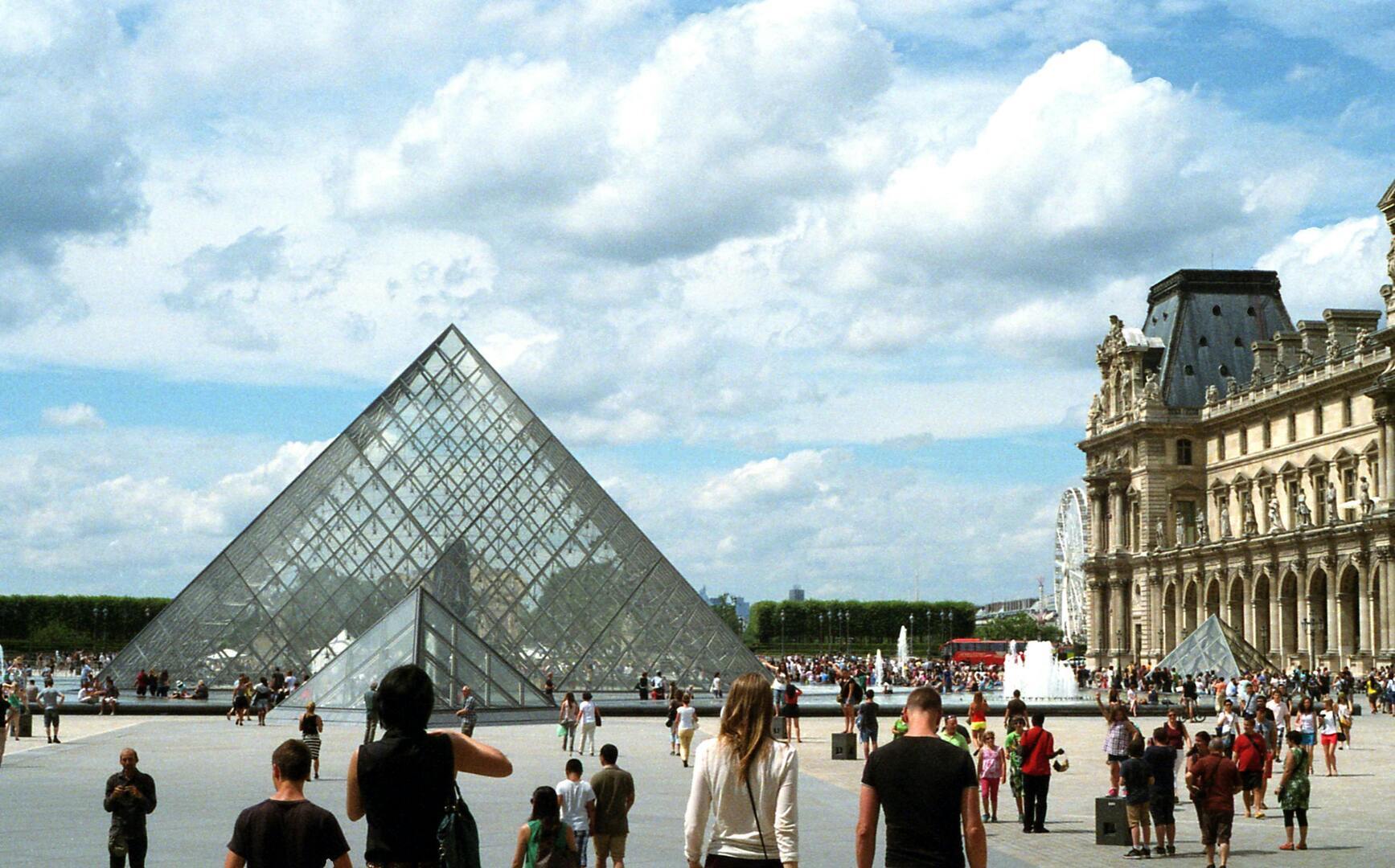
By the 1980s, the Louvre faced institutional crisis. The Ministry of Finance occupied the Richelieu Wing, limiting gallery space. Infrastructure was outdated; visitor facilities inadequate for millions of annual guests. In 1981, President François Mitterrand launched the Grand Louvre project, an ambitious modernization that would double exhibition space, relocate government offices, and create a new entrance worthy of the world's premier museum. The project's centerpiece—and most controversial element—was a glass pyramid designed by Chinese-American architect I.M. Pei.
Unveiled in 1989, Pei's pyramid sparked fierce debate. Critics condemned it as inappropriate intrusion—modernist geometry clashing with Renaissance and Classical architecture. Parisian intellectuals protested; newspapers published scathing editorials. Yet Pei's design solved practical problems elegantly. The pyramid, constructed from 673 glass segments and metal rods, floods the underground lobby with natural light while minimizing its visual footprint in the Cour Napoléon. Its 21-meter height respects the surrounding palace facades; its transparency allows views through to the architecture beyond. Functionally, it serves as entrance to the underground Carrousel du Louvre, distributing visitors efficiently to the museum's three wings.
Today, Pei's pyramid is inseparable from the Louvre's identity—featured in countless photographs, films, and promotional materials. What seemed radical in 1989 now feels inevitable, a contemporary layer in the building's ongoing evolution. The Grand Louvre project, completed in phases through 1993, transformed visitor experience: climate-controlled galleries, modern lighting, accessible facilities, and coherent circulation through renovated wings. The Richelieu Wing, reclaimed from the Finance Ministry, opened spectacular courtyards now roofed in glass, housing monumental French sculpture in natural light. The project positioned the Louvre for 21st-century challenges, from conservation to accessibility to managing record visitor numbers.
Masterpieces and Must-See Galleries
The Louvre's collection defies comprehensive viewing—at 35,000 displayed objects, seeing everything would require days. Most visitors prioritize the museum's most celebrated works, beginning with Leonardo da Vinci's Mona Lisa. Housed in the Denon Wing's Salle des États, Leonardo's portrait attracts millions annually, its enigmatic smile and revolutionary sfumato technique justifying its fame despite the crowds and protective glass that separate viewer from painting. Nearby, Veronese's monumental The Wedding Feast at Cana (1563) dominates the opposite wall—a vast canvas depicting Christ's first miracle with Renaissance Venice's architectural splendor.
Greek and Roman antiquities occupy the Denon and Sully wings, showcasing sculpture that defined Western aesthetic ideals. The Venus de Milo, discovered on the Greek island of Milos in 1820, exemplifies Hellenistic sculpture's grace—her missing arms only enhancing the mystery. The Winged Victory of Samothrace, poised at the top of the Daru staircase, captures movement in marble; this 2nd-century BCE sculpture, commemorating a naval victory, conveys dramatic energy through carved drapery and powerful wings. These works aren't merely ancient artifacts—they influenced Michelangelo, Bernini, and countless sculptors who studied them as paragons of form.
The Egyptian Antiquities department, one of the world's finest outside Cairo, displays over 50,000 objects spanning 5,000 years. Monumental sculpture includes the Great Sphinx of Tanis, colossal statues of pharaohs, and intricately carved sarcophagi. The collection illustrates daily life, religious beliefs, and artistic evolution from predynastic cultures through Roman Egypt. Near Eastern Antiquities complement this with Mesopotamian treasures: the Code of Hammurabi, one of history's oldest legal documents carved in stone; Assyrian lamassu (winged bulls) that guarded palace gates; and Persian reliefs from Darius's palace at Susa.
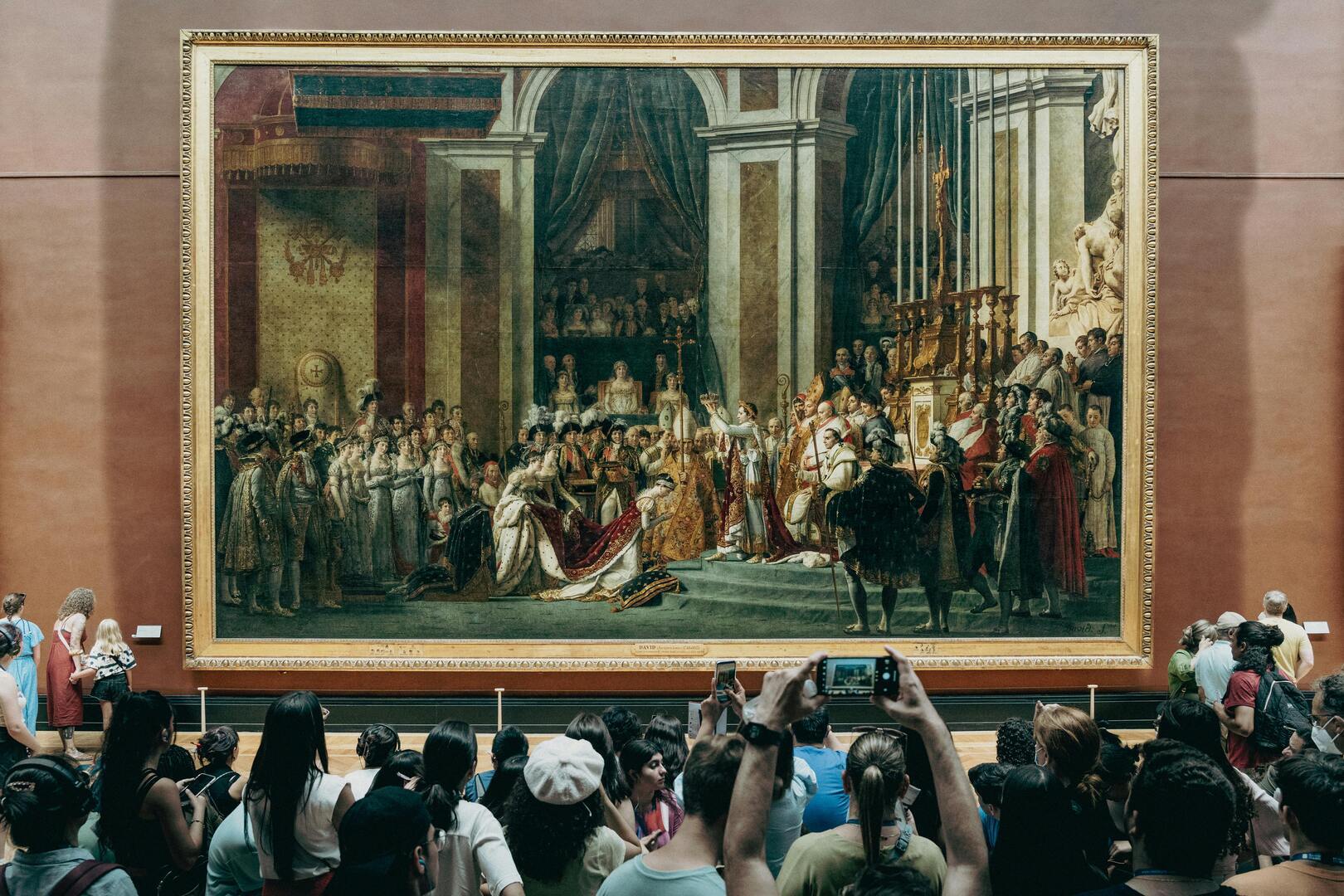
French painting galleries trace artistic development from medieval panel paintings through Romanticism. Jacques-Louis David's The Coronation of Napoleon (1807) captures the Emperor's self-coronation with documentary precision and political messaging. Eugène Delacroix's Liberty Leading the People (1830), commemorating the July Revolution, transforms political upheaval into allegorical drama—the bare-breasted Liberty, tricolor in hand, became France's revolutionary icon. Théodore Géricault's monumental The Raft of the Medusa (1819) confronts viewers with human suffering and survival, its dark Romanticism contrasting with Neoclassical restraint.
Exploring the Surrounding District
The Louvre occupies prime position within Paris's historic center, surrounded by landmarks that extend any museum visit into broader urban exploration. Directly west, the Jardin des Tuileries stretches toward Place de la Concorde—formal French gardens originally commissioned by Catherine de' Medici in the 16th century, now offering tree-lined promenades, sculptures by Rodin and Maillol, and the Jeu de Paume and Orangerie museums at opposite ends. The Tuileries provide respite after hours navigating museum galleries, their gravel paths and fountains embodying Parisian park elegance.
North of the Louvre, the Palais Royal encloses tranquil gardens surrounded by arcaded galleries housing boutiques, restaurants, and the Comédie-Française theater. Daniel Buren's controversial striped columns (1985-86) punctuate the main courtyard, their black-and-white geometry echoing Pei's pyramid in provoking initial outrage before becoming beloved. East toward the Marais district, the Rue de Rivoli—Napoleon's neoclassical thoroughfare—runs parallel to the Seine, its arcades sheltering shops and cafés.
Crossing Pont des Arts, the pedestrian bridge adorned with padlocks left by couples (periodically removed by authorities), leads to the Left Bank and Saint-Germain-des-Prés. The Musée d'Orsay, housed in a converted railway station, displays Impressionist and Post-Impressionist masterworks that chronologically follow the Louvre's collection, tracing art from 1848 to 1914. Together, the Louvre and Orsay provide comprehensive survey of Western art from ancient civilizations through early Modernism.
"The Louvre is not merely a museum—it is eight centuries of French ambition crystallized in stone, glass, and masterpiece, a declaration that art transcends the monarchs who collected it and belongs to everyone who stands before it."
Planning Your Visit
The Louvre's scale demands strategic planning. With 35,000 artworks and 15 kilometers of corridors, attempting to see everything invites exhaustion. Most visitors allocate 3-4 hours, focusing on specific collections or following curated itineraries. Advance ticket purchase (available online) is essential—the museum limits daily capacity, and popular times sell out. Entry through the Pyramid, while iconic, often accumulates lines; alternative entrances via the Carrousel du Louvre (connected to Palais Royal–Musée du Louvre Métro station) or Porte des Lions offer faster access with advance tickets.
The museum opens Wednesday through Monday (closed Tuesdays), with hours typically 9:00 a.m. to 6:00 p.m., extended to 9:45 p.m. on Fridays. Wednesday and Friday evenings offer relative calm, with fewer tour groups and softer lighting that enhances viewing. Early morning arrival (9:00-10:00 a.m.) allows contemplation of major works before crowds intensify around midday. Free admission on the first Sunday of each month attracts significant crowds but offers budget-conscious access; free admission also applies to visitors under 18 and EU residents under 26.
Photography without flash is permitted in permanent collections. The Louvre provides free maps and digital guides; audio guides (available for rental) offer commentary on selected works. Wheelchairs and strollers are accommodated; elevators connect gallery levels. Cloakrooms hold large bags (mandatory for backpacks and luggage). Multiple cafés and restaurants throughout the museum provide breaks, though leaving and reentering requires retaining your ticket. The Louvre is accessible via Métro lines 1 and 7 (Palais Royal–Musée du Louvre station) and numerous bus routes.
Experience This Attraction With Our Tours
One Journey offers curated approaches to the Louvre that provide focus and expertise, transforming what might be overwhelming into coherent narrative. Each tour recognizes that the museum's vastness requires guidance to navigate meaningfully.
Louvre: Art and Pop Culture reimagines museum viewing through contemporary lens. This guided experience connects the Louvre's classical masterpieces to modern films, music videos, fashion, and cultural references. Beginning with a mini walking tour around the museum's exterior—the Axe Historique stretching toward the Arc de Triomphe, the Tuileries Gardens where The Devil Wears Prada's Andy Sachs tossed her phone, celebrity sightings along the Champs-Élysées—the tour contextualizes the Louvre within Parisian iconography. Your guide provides timed entry tickets for optimal (less crowded) access, then equips you with an exclusive "Pop Culture In The Louvre" itinerary identifying artworks featured in music videos, films, and contemporary media. This self-guided portion (approximately 3 hours) allows exploration at your own pace while hitting Instagram-worthy hotspots. The tour appeals to those who appreciate art but seek connections beyond traditional art-historical frameworks, recognizing that the Mona Lisa exists simultaneously as Renaissance innovation and global pop culture phenomenon.
Napoleon's Legacy situates the Louvre within the Emperor's broader impact on Paris's urban landscape. This walking tour traces Napoleonic monuments throughout the city: Place Vendôme's column celebrating military victories, Rue de Rivoli named after an Italian campaign, the Arc de Triomphe du Carrousel originally intended as the Tuileries Palace entrance. At the Louvre, your guide explains how Napoleon expanded the museum's collection through military conquest—Italian Renaissance paintings, Egyptian antiquities, Flemish masterworks—and briefly renamed it the Musée Napoléon. The tour continues to Les Invalides, where Napoleon's tomb rests beneath the gilded dome, with entry included to the Army Museum's extensive military collections. For history enthusiasts, particularly those interested in how one figure reshaped a capital city's architecture and cultural institutions, this tour provides cohesive narrative linking monuments often visited in isolation.
Cinema Magic explores Paris as film location, and the Louvre appears prominently in cinematic history. From The Da Vinci Code's thriller-driven race through galleries to Wonder Woman's action sequences, from French New Wave directors capturing the museum's architectural beauty to documentaries exploring its collections, the Louvre has served as set, symbol, and subject. This three-hour walking tour visits filming locations throughout Paris, and the Louvre's exterior—particularly Pei's pyramid—features as one of cinema's most recognizable Parisian landmarks. Your guide shares behind-the-scenes stories, shows film clips against real-life backdrops, and explains how directors frame the museum to convey artistic prestige, French cultural identity, or simply stunning architecture. For film lovers, this perspective reveals how the Louvre transcends its museum function to become character in Paris's cinematic narrative.
These tours recognize that the Louvre holds multiple identities: artistic treasury, architectural palimpsest, Napoleonic legacy, pop culture icon, cinematic backdrop. One Journey's guides provide expertise that helps visitors move beyond the crowds surrounding the Mona Lisa to discover personal connections with art, history, and the museum's layered significance.
Is It Worth Visiting?
Without question. The Louvre represents one of humanity's most ambitious attempts to gather, preserve, and share artistic achievement across civilizations and millennia. Its collection spans 9,000 years—from Mesopotamian cylinder seals to Delacroix's revolutionary paintings—offering perspectives on what humans have valued, believed, and created throughout recorded history. Beyond specific masterpieces, the museum itself embodies cultural evolution: medieval fortress transformed into Renaissance palace, royal treasury opened to the public during Revolution, Napoleonic plunder reluctantly returned yet still comprising encyclopedic range, 20th-century pyramid crowning centuries of architecture. To visit the Louvre is to witness not just individual artworks but the concept of the public museum—the revolutionary idea that cultural heritage belongs to everyone, not just elites. Yes, crowds gather around the Mona Lisa. Yes, the scale can overwhelm. But the Louvre rewards strategic visits with moments of unexpected connection: a Roman sarcophagus carved with astonishing delicacy, French sculpture gleaming under the Richelieu Wing's glass roof, the Winged Victory's dramatic positioning at the top of the Daru staircase. Even spending hours there merely scratches the surface, which is precisely the point—the Louvre invites return visits, each revealing layers previously unnoticed, each reinforcing that eight centuries of accumulation cannot be absorbed in a day.
Traveler's Questions
How much time should I spend at the Louvre?
Most visitors allocate 3-4 hours, which allows focused exploration of major highlights without exhaustion. Attempting to see everything is unrealistic—the museum displays 35,000 objects across 15 kilometers of galleries. First-time visitors typically prioritize the Mona Lisa, Venus de Milo, Winged Victory, and selected galleries (Egyptian, Greek, French painting). Return visitors often explore specific departments or periods in depth. The museum's scale rewards strategic planning: choose collections that genuinely interest you rather than rushing through obligation. Museum fatigue is real; quality engagement with fewer works provides more satisfaction than superficial glimpses of everything.
Do I need to book tickets in advance?
Yes, advance online booking is strongly recommended. The Louvre limits daily capacity, and popular time slots sell out, especially during peak tourist seasons (spring through fall) and holidays. Advance tickets also allow you to choose less crowded time slots and use alternative entrances (Carrousel du Louvre or Porte des Lions) that often have shorter lines than the Pyramid entrance. Tickets are timed, so arrive within your designated window. Free admission days (first Sunday of each month) require online reservation even though entry is free, and these days attract significant crowds.
What are the best strategies for seeing the Mona Lisa?
Arrive at museum opening (9:00 a.m.) or visit during evening hours (Wednesday or Friday evenings when the museum is open until 9:45 p.m.). The Mona Lisa is housed in the Denon Wing's Salle des États; signage throughout the museum directs you there. Expect crowds and protective barriers—the painting is displayed behind glass at a distance from viewers. Visiting early morning or late evening reduces (but doesn't eliminate) crowds. Spend time with other works in the same room, particularly Veronese's Wedding Feast at Cana, which receives less attention but rewards contemplation. Consider that the Mona Lisa's fame derives partly from its history and Leonardo's technique; viewing it fulfills cultural curiosity but the Louvre holds countless less-crowded masterpieces.
Are guided tours worth it, or should I explore independently?
Both approaches have merit. Guided tours (including One Journey's offerings) provide expert context, strategic routing that maximizes time efficiency, skip-the-line access, and interpretation that connects artworks to broader historical and cultural narratives. They're particularly valuable for first-time visitors or those interested in specific themes (Napoleon's influence, pop culture connections, architectural history). Independent exploration allows personal pacing, freedom to linger where interest strikes, and flexibility to skip crowded galleries. Many visitors combine approaches: joining a guided tour for orientation and highlights, then returning independently to explore specific collections in depth. The Louvre's free maps and rental audio guides support independent visits.
What else should I see near the Louvre?
The surrounding district offers exceptional cultural and historical sites. The Jardin des Tuileries, immediately west, provides gardens, sculpture, and the Musée de l'Orangerie (housing Monet's Water Lilies) and Jeu de Paume. North, the Palais Royal encloses peaceful gardens surrounded by elegant arcades and Buren's striped columns. East along Rue de Rivoli leads toward the Marais district with its medieval streets, Jewish quarter, and Place des Vosges. Crossing the Seine via Pont des Arts leads to the Left Bank and Musée d'Orsay, whose Impressionist collection chronologically continues where the Louvre's ends. Sainte-Chapelle and the Conciergerie on Île de la Cité provide medieval and Revolutionary history. The area rewards full-day (or multi-day) exploration.
For guided Louvre tours, pop culture explorations, Napoleonic walking tours, and personalized Parisian museum experiences, contact our Tour Concierge at support@onejourneytours.com.