Notre-Dame de Paris: The Resurrected Heart of France
On the Île de la Cité, where the Seine splits around Paris's ancient core, Notre-Dame de Paris rises once more. Eight centuries of prayer, revolution, restoration, and resurrection compressed into stone and stained glass—this is the cathedral that witnessed coronations and survived desecration, that inspired Victor Hugo's romance and endured a catastrophic fire, that closed its doors in April 2019 and reopened them in December 2024 to a world that had feared it lost forever. Notre-Dame is more than Gothic masterwork or architectural triumph. It is the geographic and spiritual heart of France, the point from which all distances are measured, the monument that has absorbed and reflected the nation's tumultuous history for 861 years. To stand before its restored western facade, to witness light filtering through medieval rose windows that survived flames, is to encounter resilience embodied in limestone and devotion preserved through catastrophe.
Medieval Ambition in Stone
Notre-Dame's foundation stone was laid in 1163 under Bishop Maurice de Sully, who envisioned a cathedral worthy of Paris's growing significance as French royal capital. The site held sacred associations reaching back centuries—a Gallo-Roman temple to Jupiter, then successive Christian churches including a Merovingian basilica. But de Sully wanted something grander, a statement of Gothic innovation that would rival the new Basilica of Saint-Denis rising north of the city.
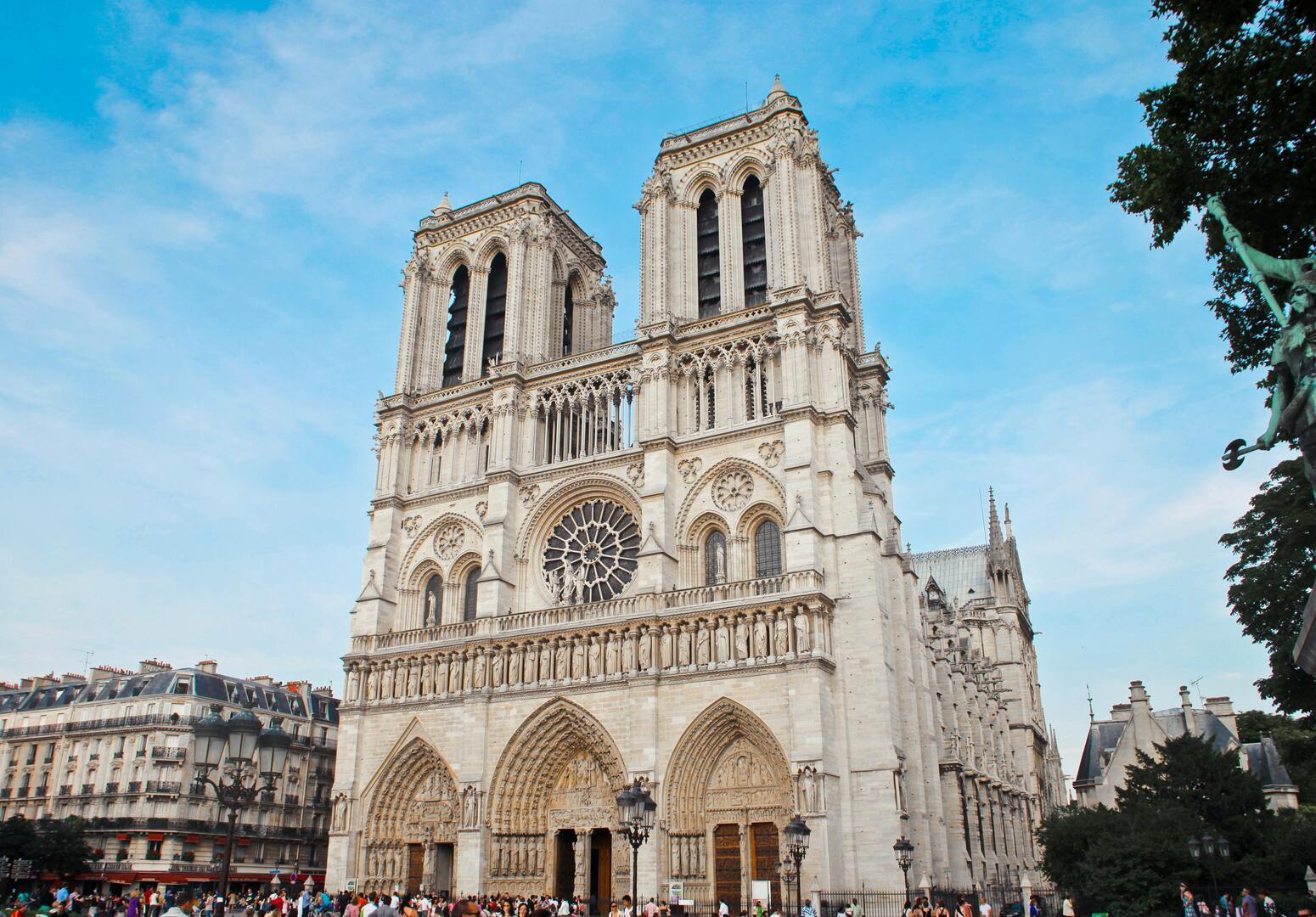
Construction unfolded across nearly two centuries, from 1163 to 1345. The choir was completed first, consecrated in 1182, allowing services to begin even as masons continued building westward. By 1250, the nave and western facade stood finished; the iconic twin towers—each rising 69 meters—were complete by 1250. The final elements, including the system of flying buttresses that defined Gothic structural daring, were added throughout the 14th century. What emerged was a masterwork of French Gothic architecture: a cruciform plan stretching 128 meters in length and 48 meters in width, capable of holding 9,000 worshippers beneath soaring rib vaults that reached 35 meters at the nave's peak.
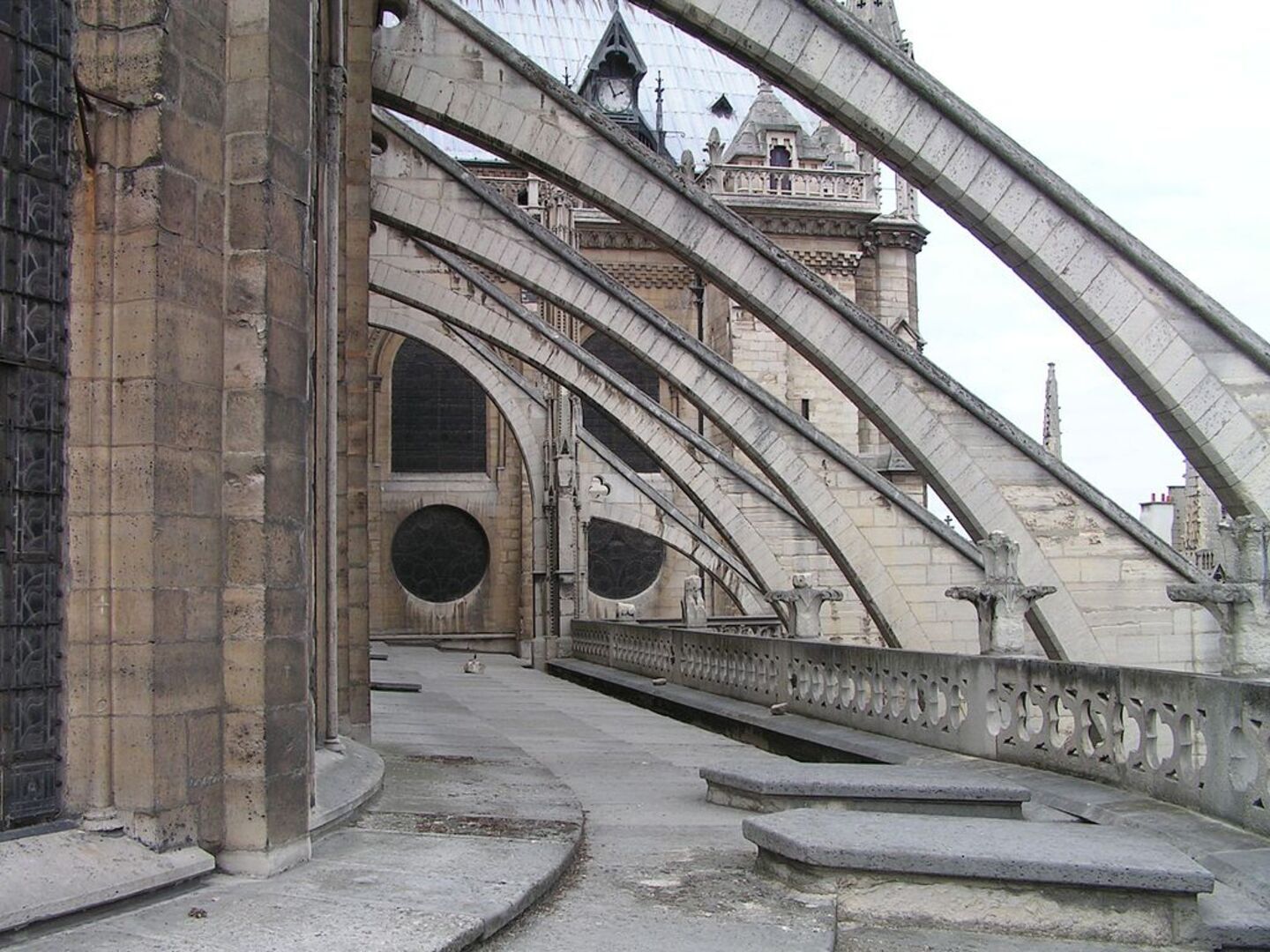
Gothic architecture revolutionized sacred building by redistributing weight through pointed arches, ribbed vaults, and external flying buttresses. These innovations allowed walls to thin, creating space for vast stained-glass windows that transformed interiors into theaters of colored light. Notre-Dame's three rose windows—particularly the north and south transept roses, each 13 meters in diameter—became defining features, their intricate tracery supporting thousands of glass pieces depicting biblical narratives, saints, and celestial symbolism. Medieval worshippers, many illiterate, read theology in glass and stone—the western facade's Portal of the Last Judgment rendered salvation and damnation in carved limestone drama.
Notre-Dame at a Glance:
- Construction: 1163–1345 (182 years)
- Length: 128 meters; Width: 48 meters; Tower height: 69 meters
- Capacity: 9,000 worshippers
- Location: Île de la Cité, 4th arrondissement, Paris
- Architectural style: French Gothic
- UNESCO World Heritage Site: Listed as part of "Paris, Banks of the Seine" (1991)
- Annual visitors: ~12 million before the 2019 fire
Revolution, Restoration, and Hugo's Rescue
Notre-Dame's fortunes mirrored France's tumultuous political cycles. The cathedral served as coronation site for English King Henry VI in 1431 and witnessed Napoleon Bonaparte crown himself Emperor in 1804, a defiant gesture asserting secular power over papal authority. But the French Revolution brought devastation. Revolutionary fervor targeted religious symbols; Notre-Dame was reconsecrated as a "Temple of Reason," then storage for food and wine. Statues of biblical kings on the western facade were beheaded (revolutionaries mistook them for French monarchs), the treasury was looted, and the cathedral's great bells were melted down—only the massive Emmanuel bell survived.
By the 1820s, Notre-Dame languished in neglect, its stone crumbling, its sculpture defaced, its stained glass shattered. Then came Victor Hugo. His 1831 novel Notre-Dame de Paris (published in English as The Hunchback of Notre-Dame) sparked cultural fascination with Gothic architecture and galvanized preservation efforts. Hugo's vivid descriptions of the cathedral's grandeur, coupled with his explicit critique of contemporary neglect, generated public pressure for restoration. The novel was as much architectural manifesto as romantic drama, and it worked.
In 1844, architect Eugène Viollet-le-Duc received commission to restore Notre-Dame. His work, spanning two decades, reconstructed the spire (which had been dismantled in the 18th century), replaced damaged sculpture, and added the now-iconic chimera gallery overlooking Paris. Viollet-le-Duc's restoration philosophy was interventionist—he didn't merely repair but reimagined, sometimes adding medieval-style elements that had never existed. His 96-meter oak-and-lead spire, topped with a copper rooster containing relics, became one of Paris's most recognizable silhouettes. The restoration saved Notre-Dame from ruin, though modern scholars debate whether Viollet-le-Duc restored or reinvented the cathedral.
The Fire and the Five-Year Resurrection
April 15, 2019. Shortly before 6:20 p.m., smoke began rising from Notre-Dame's roof. Within hours, Paris watched in horror as flames consumed the medieval oak framework—the forêt (forest), so called because its massive timber beams, some dating to the 12th century, formed a dense canopy of wood above the stone vaults. Viollet-le-Duc's 19th-century spire collapsed at 7:50 p.m., its fall captured by cameras worldwide. The fire raged through the night. For a time, it seemed all might be lost.
But firefighters saved the structure. The twin towers stood. The three rose windows—miraculously—survived, their medieval glass intact. The Crown of Thorns, Notre-Dame's most sacred relic believed to be from Christ's Passion, was rescued by chaplain Jean-Marc Fournier and firefighters who formed a human chain. By morning, the extent of damage was clear: the roof destroyed, the spire gone, water-damaged vaults compromised, but the cathedral's stone skeleton endured. President Emmanuel Macron vowed immediate reconstruction, setting an ambitious five-year deadline: Notre-Dame would reopen for the 2024 Summer Olympics.
The restoration mobilized craftspeople, historians, architects, and donors worldwide. Over 840 million euros poured in from 340,000 donors across 150 countries. Artisans reconstructed the spire using medieval techniques—1,200 oak trees felled, shaped by hand, assembled without metal fasteners where possible. The roof framework was rebuilt in oak; lead tiles replaced with identical materials. Stonework was cleaned, revealing limestone brighter than Parisians had seen in generations. The great organ, though protected, required meticulous restoration after exposure to heat, water, and lead dust—its 8,000 pipes individually cleaned and retuned.
On December 7-8, 2024, Notre-Dame reopened. The dedication ceremonies featured Mass celebrated by the Archbishop of Paris, attended by dignitaries and worshippers who had waited five years to return. The restoration honored Viollet-le-Duc's 19th-century design while incorporating 21st-century safety measures: fireproofing systems, sprinkler networks, thermal monitoring. The cathedral's interior, cleaned of centuries of soot and grime, glows with unexpected brightness. Critics debate whether this pristine appearance reflects historical accuracy or modern preference, but for most visitors, the overwhelming sensation is gratitude—Notre-Dame survived, restored, ready to witness another century of French history.
Architectural Treasures: What to See
Approaching Notre-Dame from the west, the facade reveals Gothic storytelling in stone. Three portals—dedicated to the Virgin Mary (left), the Last Judgment (center), and Saint Anne (right)—overflow with carved figures: saints, angels, demons, and allegorical representations of virtues and vices. Above, the Gallery of Kings displays 28 statues representing Judean monarchs (19th-century replacements for the originals destroyed during the Revolution). The western rose window, 9.6 meters in diameter, sits like a jeweled eye above the gallery, its tracery forming geometric perfection.
Inside, the nave extends 130 meters toward the choir, ribbed vaults soaring overhead. The restoration has revealed stone's natural cream and gray tones, brighter than most visitors remember. The three rose windows dominate: the western rose depicting the Virgin, the north rose showing Old Testament figures surrounding the Virgin and Child, and the south rose illustrating Christ surrounded by apostles and saints. Light filtering through these medieval masterworks shifts throughout the day, painting colored patterns across limestone pillars.
The flying buttresses, best viewed from the Rive Gauche (Left Bank) along the Seine, demonstrate Gothic engineering genius. These stone arches transfer the vault's outward thrust away from walls, allowing interior space to open up for windows. Each buttress spans 15 meters, some adorned with sculpture, creating a rhythmic exterior arcade. From Square Jean XXIII behind the cathedral, visitors gain perspective on Notre-Dame's architectural complexity—buttresses, pinnacles, gargoyles, and the reconstructed spire all visible in profile.
The bells, housed in the twin towers, carry historical and literary resonance. Emmanuel, the bourdon (largest bell) weighing 13 tons, survived the Revolution. Smaller bells were melted down but replaced in the 19th century and again in 2013 for Notre-Dame's 850th anniversary. These are the bells that Victor Hugo's Quasimodo rang, that mark hours and festivals, that tolled across Paris as the 2019 fire burned, and that rang again in celebration when the cathedral reopened.
Exploring the Île de la Cité
Notre-Dame anchors the Île de la Cité, the island considered Paris's birthplace. The Parisii tribe settled here in the 3rd century BC; Romans later built Lutetia on this strategic river crossing. Today, the island retains medieval and Renaissance architecture alongside the cathedral. The Parvis Notre-Dame—the plaza facing the cathedral's western facade—contains Point Zéro, a bronze marker from which all distances in France are officially measured. This symbolic designation reinforces Notre-Dame's status as the nation's geographic and spiritual center.
Walking around the cathedral, visitors encounter complementary monuments. Sainte-Chapelle, built in the 13th century by King Louis IX to house Christ's Crown of Thorns (now kept in Notre-Dame), dazzles with floor-to-ceiling stained glass in its upper chapel—15 windows depicting over 1,000 biblical scenes. The Conciergerie, originally a royal palace, became a Revolutionary prison where Marie Antoinette spent her final days before execution. These landmarks, all within a ten-minute walk, create a historical circuit tracing Paris from medieval piety through royal power to Revolutionary upheaval.
The Seine riverbanks, designated a UNESCO World Heritage Site, offer ideal vantage points for photographing Notre-Dame. The Pont de l'Archevêché (Archbishop's Bridge) directly south provides classic views of the cathedral's flying buttresses and reconstructed spire. The Quai de Montebello on the Left Bank, with its bouquinistes (booksellers) lining the river, frames Notre-Dame against changing sky and water. Early morning or late afternoon light produces the most dramatic images, the limestone glowing golden in slanted sun.
"To witness Notre-Dame's resurrection is to understand that some stones carry more than weight—they carry memory, identity, and the stubborn refusal to let history end."
Planning Your Visit
Notre-Dame's reopening brought new visitor protocols. Entry to the cathedral remains free, but timed reservations are now required to manage capacity and ensure safety. Visitors book slots through the cathedral's official website or authorized tour operators. This system prevents overwhelming crowds while preserving access for worshippers and travelers alike. Services are held daily; attending Mass offers a chance to experience Notre-Dame as functioning cathedral rather than tourist attraction.
Modest dress is required—shoulders and knees covered. Security screening at entrances is standard. Photography inside is permitted without flash, though restrictions apply during services. The treasury, displaying religious artifacts and relics including fragments of the Crown of Thorns, requires a separate ticket. Tower access, offering views from the Gallery of Chimera and close-up inspection of Emmanuel and other bells, is limited and reservable separately.
The best times to visit are early morning (shortly after opening) or late afternoon on weekdays. Sundays draw worshippers for services; religious holidays see even larger crowds. Winter months, particularly January and February, offer the quietest experience, though shorter daylight hours limit exterior photography. Spring and autumn provide ideal weather without summer's peak tourist influx. The cathedral and Île de la Cité are easily accessible via Métro lines 4 (Cité or Saint-Michel stations) and RER lines B and C (Saint-Michel–Notre-Dame station).
Experience This Attraction With Our Tours
One Journey offers several ways to encounter Notre-Dame's history, architecture, and significance within Paris's broader story. Each tour provides context that transforms the cathedral from monument into narrative.
The Notre-Dame Walking Tour dedicates a full hour to the cathedral and its surrounding Île de la Cité landscape. Beginning at Quai de Montebello with views across the Seine, the tour explores Notre-Dame's exterior in detail—the flying buttresses, the western facade's Portal of the Last Judgment, the Gallery of Kings, the reconstructed spire visible against sky. Your guide explains the Gothic engineering that makes Notre-Dame possible, the symbolism carved into every portal, and the dramatic events of the 2019 fire and subsequent restoration. The guided portion concludes with historical context that enriches a self-guided interior visit, allowing you to recognize architectural features and understand the cathedral's layered significance beyond its immediate visual impact.
Original Paris by Walking situates Notre-Dame within the Île de la Cité's broader medieval landscape. This three-hour tour begins at Pont Neuf, Paris's oldest standing bridge, and explores the island where Paris itself began. Stroll along the Seine past bouquinistes, visit the 14th-century Clock Tower, pause at the golden gates of Palais de Justice, and discover Point Zéro where all French distances are measured. Notre-Dame appears not as isolated landmark but as anchor of an island that witnessed two millennia of Parisian history. The tour includes tickets to Sainte-Chapelle, the 13th-century jewel box whose stained glass complements Notre-Dame's own rose windows, creating a dialogue between two Gothic masterworks separated by mere streets and decades.
For those visiting during the holiday season, Paris Christmas Market Experience begins at Notre-Dame, using the cathedral as both meeting point and atmospheric backdrop. The tour explores the cathedral's significance and ongoing restoration before moving to the Square René Viviani Christmas Market along the Seine. Notre-Dame, illuminated against December evenings, provides festive context—resilience and renewal embodied in stone, appropriate symbolism for a season celebrating hope and rebirth. This shorter experience blends architectural appreciation with holiday traditions, gourmet tastings, and artisanal shopping in the cathedral's immediate surroundings.
Cinema Magic incorporates Notre-Dame within a broader cinematic tour of Paris. The cathedral appears in countless films—from Disney's The Hunchback of Notre-Dame to modern dramas capturing its Gothic grandeur. This walking tour traces famous film locations throughout the city, and Notre-Dame features prominently as one of cinema's most recognizable Parisian landmarks. For film enthusiasts, this perspective reveals how directors and cinematographers have framed the cathedral across decades, how its image has been deployed to signify Paris itself, and how the 2019 fire became global news partly because Notre-Dame's cinematic presence had embedded it in collective imagination worldwide.
Each tour approaches Notre-Dame differently—architectural deep dive, historical context within medieval Paris, seasonal atmosphere, or cinematic legacy—recognizing that a single building can hold multiple stories. One Journey's guides, many with backgrounds in art history, architecture, or French cultural studies, provide the depth that transforms sightseeing into understanding.
Is It Worth Visiting?
Absolutely. Notre-Dame's reopening marks one of the most significant cultural events in recent Parisian history. To witness the cathedral restored after the trauma of 2019 is to see resilience made tangible. Beyond its religious significance, Notre-Dame represents eight centuries of French identity—coronations and revolutions, Hugo's literary intervention, Viollet-le-Duc's controversial restoration, the fire's devastating night, and now the meticulous reconstruction. The interior, brighter than memory serves, the spire once again piercing skyward, the rose windows filtering light as they have for 750 years—these are not merely architectural features but testimonies to human determination to preserve what matters. Even for secular visitors, Notre-Dame resonates as more than building. It is monument to collective will, to the idea that some places are too important to lose, that history deserves not passive observation but active stewardship. To stand in the nave, to look up at vaults that survived flames, is to feel grateful that this particular conversation between past and present continues.
Traveler's Questions
Is Notre-Dame open to the public now?
Yes, Notre-Dame reopened in December 2024 following five years of restoration after the April 2019 fire. Entry to the cathedral is free, but timed reservations are now required through the official website or authorized tour operators. This reservation system manages visitor capacity while ensuring access for both worshippers and travelers. Daily Mass and religious services continue; attending worship provides an authentic experience of Notre-Dame as functioning cathedral rather than solely tourist attraction.
How much of the cathedral survived the 2019 fire?
The stone structure survived intact—the twin towers, exterior walls, and the three magnificent rose windows all endured. The medieval oak roof framework (called the forêt) was destroyed, as was Viollet-le-Duc's 19th-century spire, which collapsed during the fire. Water damage affected some vaulting, and the interior suffered from heat, smoke, and lead contamination. The five-year restoration rebuilt the roof and spire using traditional methods, cleaned and restored stonework, and preserved or repaired the stained glass, great organ, and sacred relics. The result honors historical accuracy while incorporating modern fireproofing and safety systems.
Can I climb the towers for views?
Tower access is available through separate timed reservations, independent from general cathedral entry. The climb involves 387 steps (no elevator) to reach the Gallery of Chimera, where you can see the cathedral's famous gargoyles and chimeras up close, plus panoramic Paris views. Further ascent leads to the bells, including the massive Emmanuel bell that has rung for major events since 1681. Tower access is limited for preservation and safety reasons; book well in advance, especially during peak tourist seasons.
What is the Crown of Thorns, and can I see it?
The Crown of Thorns is a relic believed to be from Christ's Passion, acquired by French King Louis IX in 1238 and originally housed in Sainte-Chapelle before being transferred to Notre-Dame. During the 2019 fire, chaplain Jean-Marc Fournier and firefighters heroically rescued it along with other sacred artifacts. The Crown is displayed in the cathedral's treasury, which requires a separate ticket. It is presented for veneration on the first Friday of each month and during Holy Week, drawing pilgrims and those interested in medieval Christian relics.
What else should I visit nearby?
The Île de la Cité offers exceptional nearby monuments. Sainte-Chapelle, a five-minute walk, features stunning 13th-century stained glass depicting over 1,000 biblical scenes. The Conciergerie, once a royal palace and later Revolutionary prison where Marie Antoinette was held, provides historical context to French political upheaval. Point Zéro, marked on the pavement in front of Notre-Dame, designates the point from which all distances in France are measured. The bouquinistes (booksellers) along the Seine's banks sell vintage books, prints, and souvenirs. Shakespeare and Company bookshop, across Pont au Double on the Left Bank, offers English-language books and literary atmosphere.
For guided Notre-Dame tours, Île de la Cité explorations, and personalized Parisian experiences, contact our Tour Concierge at support@onejourneytours.com.