Napoleon's Paris: How One Emperor Shaped a Capital
Few individuals have left as profound an architectural and cultural imprint on a city as Napoleon Bonaparte on Paris. The Corsican general who crowned himself Emperor in 1804 spent fifteen years transforming the French capital from a medieval muddle into a neoclassical showcase of imperial power. His vision—equal parts military propaganda, urban reform, and aesthetic ambition—gave Paris the monuments, streets, and institutions that still define its identity. The Arc de Triomphe crowning the Champs-Élysées. The Vendôme Column celebrating military victories. The Rue de Rivoli's elegant arcades. The Louvre's expanded galleries filled with plundered masterpieces. Even the cemeteries where Parisians rest. These weren't random beautifications but calculated statements about French grandeur, Napoleon's legacy, and the emperor's place in history alongside Caesar and Alexander. Yet Napoleon's Paris also reveals contradictions: enlightened reforms alongside autocratic control, genuine modernization coupled with shameless self-promotion, classical restraint mixed with bombastic military symbolism. To walk through Napoleonic Paris today is to witness how one man's ego, when paired with political power and aesthetic judgment, can reshape an entire city—and in doing so, create much of what millions now consider quintessentially Parisian.
The Corsican Who Became Emperor
Napoleon Bonaparte was born on August 15, 1769, in Ajaccio, Corsica—the island had been sold to France by Genoa just a year earlier. His family belonged to the minor Corsican nobility, positioned between Italian and French cultures, neither truly wealthy nor entirely poor. Young Napoleon received a scholarship to military school in France, where his Corsican accent and modest origins made him an outsider among aristocratic cadets. He compensated with ferocious study, particularly military history and mathematics, graduating in 1785 as a second lieutenant in the artillery.
The French Revolution proved his crucible. While many aristocratic officers fled France or faced the guillotine, Napoleon's talents found opportunity in the chaos. His brilliant defense of Toulon in 1793—using artillery to force out British and Spanish forces—earned him promotion to brigadier general at just twenty-four. The coup of 18 Brumaire in November 1799 brought him to power as First Consul, and five years later, on December 2, 1804, he crowned himself Emperor of the French in Notre-Dame Cathedral. In that symbolic gesture—taking the crown from Pope Pius VII's hands and placing it on his own head—Napoleon declared his authority derived not from divine right or papal blessing but from his own achievement and will.
His empire stretched from the Atlantic to the Russian frontier, from the North Sea to southern Italy. He reformed law with the Napoleonic Code, reorganized European boundaries, abolished feudalism in conquered territories, and spread revolutionary ideals even while building an autocratic state. But military overreach—the catastrophic Russian campaign of 1812, the Peninsular War in Spain, the growing coalition of European powers determined to contain France—eventually undid him. Abdication in 1814, exile to Elba, the Hundred Days comeback culminating in defeat at Waterloo in 1815, and final exile to remote Saint Helena, where he died on May 5, 1821. His body returned to Paris in 1840, interred beneath the golden dome of Les Invalides, the military complex he had expanded and which now serves as his eternal monument.
Napoleon at a Glance:
- Born: August 15, 1769, Ajaccio, Corsica
- Died: May 5, 1821, Saint Helena (age 51)
- Ruled France: 1799–1814, 1815 (the Hundred Days)
- Emperor of the French: 1804–1814, 1815
- Major battles: Austerlitz, Jena, Wagram, Borodino, Waterloo
- Height: Approximately 5'7" (170 cm)—average for his time, contrary to "short" myth
- Marriages: Joséphine de Beauharnais (1796–1810); Marie Louise of Austria (1810–1821)
- Legitimate heir: Napoleon II, King of Rome (1811–1832)
Paris Under Napoleon: Urban Transformation
When Napoleon came to power in 1799, Paris remained largely medieval—narrow streets that turned to mud when it rained, inadequate water supply, no unified street numbering, virtually no public lighting. Napoleon viewed this as unacceptable for the capital of what he intended to be Europe's dominant empire. His urban reforms combined practical improvements with monumental propaganda, transforming Paris into a modern city while celebrating his military victories and imperial authority.
Infrastructure improvements came first. Napoleon established the street numbering system still used today—odd numbers on one side, even on the other, beginning at the Seine. He built the Ourcq Canal to bring fresh water to Paris, improving both public health and supplying the fountains he commissioned throughout the city. Gas lighting appeared on streets and bridges, making Paris safer after dark. Covered markets replaced chaotic open-air affairs. Quays were built along the Seine to prevent flooding and create promenades. The Pont des Arts, Paris's first iron bridge, opened in 1804—a pedestrian crossing linking the Louvre to the Left Bank, symbolizing both technological progress and accessibility to culture.
The Rue de Rivoli exemplified Napoleon's urban vision. This broad thoroughfare, begun in 1802 and named after his 1797 victory in Italy, runs parallel to the Tuileries Palace (then Napoleon's residence) with elegant arcaded facades designed by architects Charles Percier and Pierre Fontaine. The uniform neoclassical architecture—symmetrical, restrained, dignified—established a template for Parisian streets. Napoleon intended the Rue de Rivoli to extend across Paris, though only a portion was completed during his rule; later rulers continued the project, eventually creating the east-west artery linking the Place de la Concorde to the Marais.
Napoleon also reformed Parisian institutions. He established the Lycée system for secondary education. He reorganized the Comédie-Française and Opera. He created new cemeteries—Père Lachaise, Montparnasse, and Montmartre—moving burials outside the city center for public health reasons while creating landscaped memorial parks that became tourist destinations. These reforms outlasted his reign precisely because they solved genuine urban problems rather than serving solely as propaganda, though Napoleon certainly ensured his contributions were recognized through plaques, inscriptions, and ceremonial openings.

Monuments to Glory: The Arc de Triomphe and Vendôme Column
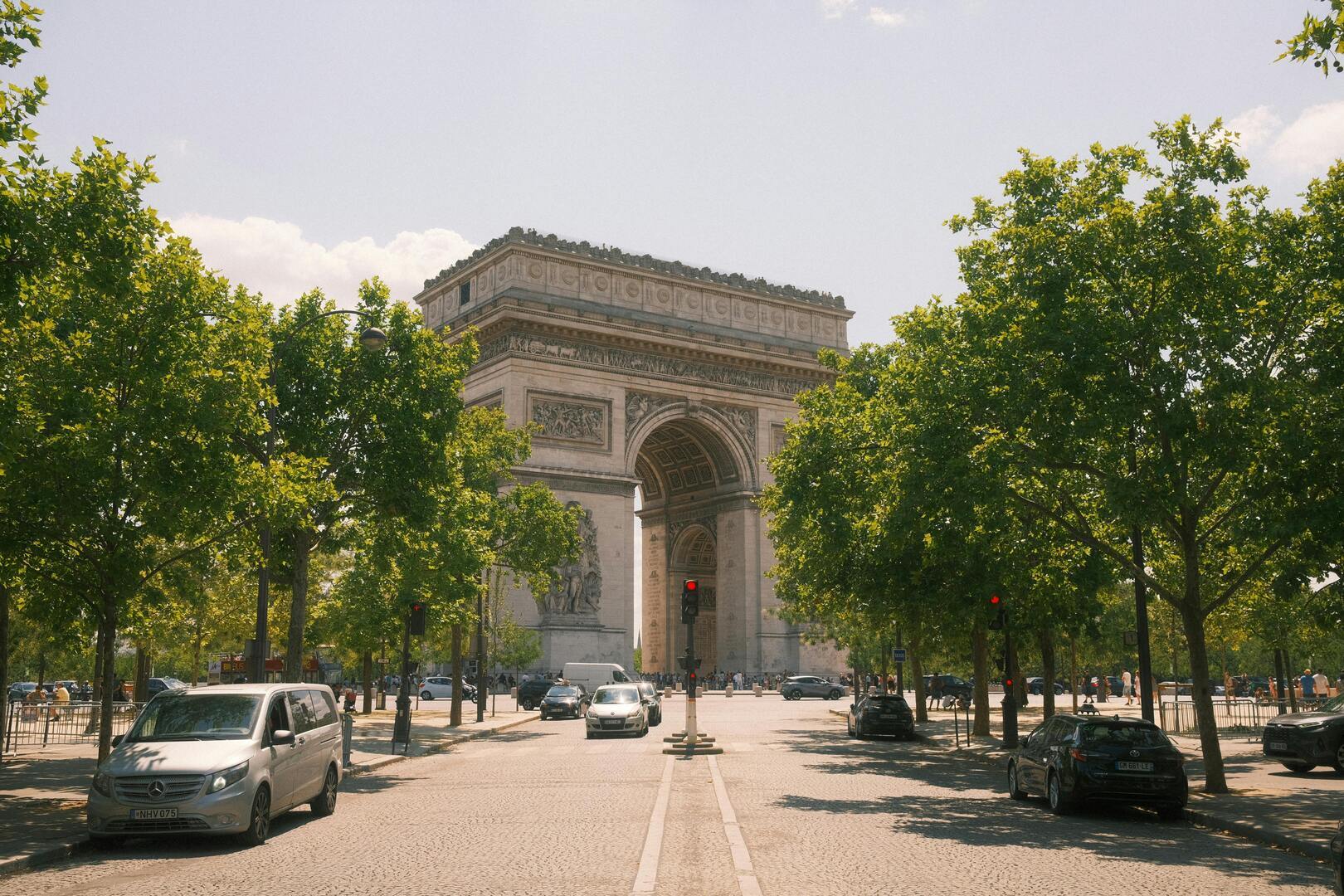
Napoleon's most visible legacy in Paris comes through monuments designed to proclaim military triumph and imperial grandeur. The Arc de Triomphe, commissioned in 1806 after the victory at Austerlitz, stands at the center of the Place de l'Étoile (now Place Charles de Gaulle), crowning the Champs-Élysées. Inspired by Roman triumphal arches, it was designed by Jean Chalgrin to honor the Grande Armée—Napoleon's military force that conquered most of Europe. The arch reaches 50 meters high and 45 meters wide, making it one of the world's largest triumphal arches. Construction proceeded slowly, and Napoleon never saw it completed; the arch was finished only in 1836, fifteen years after his death.
Yet the Arc de Triomphe ultimately received its most fitting consecration in 1840, when Napoleon's remains, returning from Saint Helena, passed beneath it en route to Les Invalides. The arch's surfaces are covered with relief sculptures celebrating Napoleonic victories: François Rude's Departure of the Volunteers of 1792 (commonly called La Marseillaise) on the right face, allegorical figures representing victories at Austerlitz and Aboukir, and the names of generals and battles inscribed on interior surfaces. Today it serves as memorial to all French military dead, housing the Tomb of the Unknown Soldier beneath its vault, with an eternal flame rekindled daily at 6:30 p.m.—a ceremony open to public viewing.
The Vendôme Column, erected between 1806 and 1810 in Place Vendôme, took more direct inspiration from Trajan's Column in Rome. Standing 44 meters tall, it was cast from bronze melted down from cannons captured at Austerlitz. A spiral frieze winds from bottom to top—a three-dimensional "comic strip" depicting the military campaigns of 1805 in 425 carved relief panels. Originally topped with a statue of Napoleon dressed as a Roman emperor, the column has suffered turbulent history: the statue was melted down during the Restoration, replaced under Louis-Philippe, toppled during the Paris Commune in 1871 (at the instigation of artist Gustave Courbet), and rebuilt. Today's statue, installed in 1875, shows Napoleon in his trademark bicorne hat and military coat, surveying the elegant square that became synonymous with luxury jewelry since Cartier established its boutique there in 1899.
A smaller triumphal arch, the Arc de Triomphe du Carrousel, stands in the Tuileries Garden between the Louvre wings. Completed in 1808, it originally served as ceremonial entrance to the Tuileries Palace where Napoleon resided. This arch, inspired by the Arch of Constantine in Rome, is more intimate in scale—15 meters high—and was topped with the famous bronze horses Napoleon had looted from St. Mark's Basilica in Venice. After his fall, the horses were returned to Venice (where they remain today), and the arch received a new sculptural group celebrating the Restoration of the Bourbons, which was itself later replaced with a sculpture celebrating the Restoration of the monarchy—a history of political symbolism written in bronze.
The Louvre and Les Invalides: Napoleon's Cultural Monuments
Napoleon's relationship with the Louvre reveals his complex legacy—military plunderer and genuine art patron in one. When he came to power, the museum established by the Revolution contained primarily French royal collections. Napoleon dramatically expanded it through systematic looting, as his armies swept across Europe carrying back Italian Renaissance masterpieces, Flemish paintings, German altarpieces, and ancient sculptures. For a time, the museum was renamed the Musée Napoléon, and its galleries became showcases for conquered treasures: Veronese's Wedding at Cana from Venice, Raphael's Transfiguration from Rome, countless works from churches, palaces, and noble collections across Europe.
Yet Napoleon also improved the museum. He expanded gallery space, organized collections systematically, improved lighting and display, and made the Louvre accessible as public institution. His vision of Paris as a cultural capital required a world-class museum, and the Louvre under his rule became precisely that—even if the means of acquisition were ethically dubious. After his fall at Waterloo, the Congress of Vienna in 1815 mandated the return of looted artworks, and European delegations arrived in Paris to reclaim their treasures. Many were indeed returned, though France retained significant works either through political negotiation, claims of having "saved" them from revolutionary destruction, or simply by moving certain pieces to provincial museums where recovery proved difficult. Today's Louvre still houses works acquired during this period, their provenance a reminder of how museums and empires intertwined in the 19th century.
Les Invalides represents Napoleon's most personal monument. Originally built by Louis XIV as a hospital and retirement home for war veterans, the complex features a golden-domed church designed by Jules Hardouin-Mansart. Napoleon expanded the complex and improved conditions for veterans. After his death on Saint Helena in 1821, his body remained buried on that remote island for nineteen years. King Louis-Philippe negotiated with Britain for its return, and on December 15, 1840, Napoleon's remains arrived in Paris. Millions lined the streets as the funeral cortège proceeded from the Arc de Triomphe, down the Champs-Élysées, across Place de la Concorde, and along the Seine to Les Invalides, where the body was interred in the crypt of the Dôme des Invalides.
Napoleon's tomb, designed by architect Visconti and completed in 1861, occupies a circular crypt open to the church above. The sarcophagus is carved from red quartzite, surrounded by reliefs depicting his achievements—the Napoleonic Code, the Concordat with the Catholic Church, his public works. Twelve colossal statues representing his victories ring the crypt. The gilded dome rises 107 meters above, visible across Paris as beacon announcing Napoleon's eternal presence in the city he transformed. The Musée de l'Armée, one of the world's largest military museums, occupies the surrounding buildings, displaying armor, weapons, uniforms, and artifacts spanning French military history from medieval times through World War II, with extensive Napoleonic galleries featuring the Emperor's personal effects, battle maps, and campaign memorabilia.
Discovering Napoleon's Paris on Foot
The concentration of Napoleonic monuments in central Paris makes them ideal for walking tours that reveal how one ruler's vision shaped an entire capital. Begin at Place Vendôme, the elegant octagonal square dominated by the Vendôme Column. The square itself predates Napoleon—designed by Jules Hardouin-Mansart for Louis XIV—but the column's spiral frieze celebrating the 1805 campaign makes it unmistakably Napoleonic. The luxury boutiques now occupying the square's ground floors (Chaumet, Van Cleef & Arpels, Dior) represent a different kind of French prestige, though one Napoleon would likely appreciate given his attention to French luxury industries.
From Place Vendôme, walk west through the Tuileries Garden, passing the Arc de Triomphe du Carrousel—Napoleon's ceremonial entrance to his residence in the now-vanished Tuileries Palace. The gardens themselves were redesigned during Napoleon's time by architects Percier and Fontaine, who added fountains, parterres, and the elevated terrace offering views toward the Place de la Concorde. This square, originally Place Louis XV, became Place de la Révolution during the Terror (where Louis XVI and Marie Antoinette were guillotined), and was renamed Place de la Concorde during Napoleon's Consulate as symbolic gesture toward national unity after revolutionary violence. The Egyptian obelisk at its center, gifted to France in 1831, arrived after Napoleon's death but reflects his fascination with Egypt following his 1798 campaign.
Continue up the Champs-Élysées—the grand boulevard Napoleon improved with sidewalks, lighting, and tree plantings—toward the Arc de Triomphe. The 2.7-kilometer walk from Place de la Concorde to the Arc traces what's often called the Voie Triomphale (Triumphal Way), an axis extending from the Louvre through the Tuileries, across the Champs-Élysées, to the arch. This was Napoleon's vision: a monumental perspective celebrating French power and his own military achievements. Today, it remains Paris's ceremonial route for military parades, state processions, and the Tour de France finish line. The Arc de Triomphe itself rewards the climb up 284 steps to its platform, offering panoramic views across Paris and down the twelve avenues radiating from the Place de l'Étoile—a urban plan that predated Napoleon but which he incorporated into his grand vision for Paris.
Return to the Seine and walk along its quays toward Les Invalides, crossing via the Pont Alexandre III—a bridge built for the 1900 Exposition Universelle but whose ornate Belle Époque decoration honors the Franco-Russian Alliance. The golden dome of Les Invalides rises ahead, visible from across Paris as Napoleon intended. The Esplanade des Invalides, a vast formal lawn stretching from the Seine to the complex entrance, was Napoleon's creation, designed for military reviews and parades. Inside the complex, the Musée de l'Armée chronicles French military history, with extensive galleries devoted to Napoleon's campaigns, personal effects, and the evolution of his legend. The tomb in the Dôme des Invalides provides a fitting conclusion to any Napoleonic walking tour—the emperor's eternal rest beneath the golden dome in the city he transformed.
"I wished to found a European system, a European Code of Laws, a European judiciary; there would be but one people in Europe." — Napoleon Bonaparte, reflecting on Saint Helena about his ambitions for unifying Europe under French principles
Practical Guidance for Exploring Napoleonic Paris
Most Napoleonic monuments are free to view from the exterior, making them accessible for budget-conscious travelers. The Arc de Triomphe charges admission to climb to its platform (approximately €13 for adults; free for EU residents under 26 and everyone under 18), with access via the underground passage from the Champs-Élysées to avoid the chaotic traffic circle. The platform offers incomparable views across Paris, and interpretive displays inside document the arch's history and the Unknown Soldier tradition. Hours are typically 10:00 a.m. to 10:30 p.m. (later in summer), though last entry is 45 minutes before closing.
Les Invalides and the Musée de l'Armée require tickets (approximately €15 for adults; free for under 18s and EU residents under 26), which include access to Napoleon's Tomb, the military museum galleries, and temporary exhibitions. The complex opens daily (except the first Monday of each month) from 10:00 a.m. to 6:00 p.m., with extended hours in summer. Allow at least two hours to explore the Napoleonic galleries, tomb, and architectural splendor of the Dôme des Invalides. Photography is permitted without flash. The nearest Métro stations are Invalides (Line 8, RER C) and Varenne (Line 13).
Walking between sites is recommended to appreciate Napoleon's urban vision—the boulevards, perspectives, and monumental axes he created to transform Paris into a neoclassical showcase. Most Napoleonic monuments cluster in the 1st, 7th, and 8th arrondissements, within walking distance of each other. Comfortable shoes are essential; Paris streets alternate between smooth pavement and uneven cobblestones. Spring (April-May) and fall (September-October) offer mild weather ideal for extended walking; summer brings crowds and heat, while winter means shorter daylight hours but fewer tourists and atmospheric lighting on monuments. Consider morning visits to monuments before crowds arrive, saving afternoons for the Musée de l'Armée where indoor exploration is comfortable regardless of weather.
Experience This Attraction With Our Tours
Understanding Napoleon's impact on Paris benefits from expert guidance that connects individual monuments into a coherent narrative. One Journey's Napoleon's Legacy: A Paris Walking Tour with Army Museum Visit provides exactly this comprehensive exploration, tracing the Emperor's architectural and cultural footprint across the capital over three hours.
The tour begins at Place Vendôme, where the Vendôme Column's spiral reliefs tell the story of the 1805 campaign in bronze cast from captured cannons. Your guide explains how Napoleon used monuments as propaganda—celebrating military victories while establishing his legitimacy as ruler. From there, the route follows Rue de Rivoli, Napoleon's elegant thoroughfare named after his Italian victory, where uniform neoclassical facades demonstrate his vision for Parisian architecture: dignified, symmetrical, unmistakably imperial.
Continuing through the Tuileries Garden and past the Arc de Triomphe du Carrousel—Napoleon's ceremonial entrance to his palace residence—the tour reveals layers of history often missed when viewing monuments individually. At Place de la Concorde, your guide recounts the square's transformation from revolutionary execution site to Napoleon's gesture toward national reconciliation. The walk continues to the Arc de Triomphe, where discussion covers not just the monument's construction but Napoleon's broader urban planning: the grand perspectives, the radiating avenues, the neoclassical aesthetic that still defines central Paris.
The tour culminates at Les Invalides, where included entry to the Musée de l'Armée allows self-guided exploration of the Napoleonic galleries and the Emperor's tomb. After the walking portion with your guide, you're free to spend as much time as you wish examining military artifacts, personal effects, and the stunning architecture of the Dôme des Invalides. This combination—guided context for monuments followed by independent museum exploration—provides both expertise and flexibility, ensuring you understand Napoleon's significance while exploring personal interests at your own pace.
The tour runs daily at 11:00 a.m., lasting approximately three hours (1.5 hours guided walking, then self-guided museum time). Groups remain small—maximum 15 participants—allowing for questions and conversation. Comfortable walking shoes are essential; the route covers approximately 3 kilometers on varied surfaces. Tours operate in all weather, though Paris rain can be persistent, so appropriate outerwear is recommended. The €52 per person cost includes the guided walking tour, entry ticket to the Musée de l'Armée and Napoleon's Tomb, and the expertise of guides trained in Napoleonic history and Parisian architecture. It's an investment in understanding how one controversial figure's ambition reshaped a capital city into the Paris we recognize today.
Is It Worth Visiting?
Absolutely. Napoleon's Paris offers something rare in modern travel: the opportunity to trace how one individual's vision—for better and worse—transformed an entire capital city. Unlike ancient monuments built over centuries by successive rulers, or contemporary cities shaped by democratic planning committees, Napoleon's Parisian legacy is remarkably coherent. Walking from Place Vendôme to the Arc de Triomphe, from the Louvre to Les Invalides, you witness a unified aesthetic: neoclassical restraint, monumental scale, careful urban perspectives that frame views and create dramatic approaches. The monuments aren't merely beautiful architecture; they're propaganda, military celebration, urban planning, and cultural ambition materialized in stone and bronze. Understanding this context—that the Arc de Triomphe celebrates victories that cost hundreds of thousands of lives, that the Louvre's collection includes works looted from conquered territories, that street names commemorate battles—adds layers of complexity to appreciation. Napoleon was neither simple hero nor straightforward villain; his legacy combines genuine administrative reforms and infrastructure improvements with autocratic control and military aggression. Paris bears witness to this duality: a city transformed into something undeniably magnificent through means that remain ethically problematic. For travelers interested in history, architecture, military affairs, or simply understanding how cities evolve, Napoleon's Paris rewards sustained attention. The monuments endure, beautiful and troubling, magnificent and propagandistic—testaments to how one person's ambition, when paired with political power and competent architects, can reshape urban space for centuries.
Traveler's Questions
Can I visit all the major Napoleonic sites in one day?
It depends on your pace and priorities. Walking from Place Vendôme through the Tuileries to the Arc de Triomphe, then returning to Les Invalides, is physically achievable in half a day. However, this approach allows only exterior viewing and photos. If you want to climb the Arc de Triomphe (recommended for views and historical exhibits) and explore the Musée de l'Armée and Napoleon's Tomb thoroughly, allocate a full day. The Army Museum alone warrants 2-3 hours if you're genuinely interested in military history and Napoleon's campaigns. Consider spreading visits across two days: one for walking tours and monument exteriors, another dedicated to the Musée de l'Armée and related collections. This prevents exhaustion and allows each site proper attention.
How historically accurate are Napoleon's monuments—do they tell the truth?
Napoleon's monuments are propaganda first, historical record second. The Arc de Triomphe and Vendôme Column celebrate victories while omitting defeats like the Russian campaign disaster or Waterloo. The reliefs on the Vendôme Column depict military success but not the hundreds of thousands who died in those campaigns. Napoleon's tomb at Les Invalides presents him as great statesman and lawgiver, emphasizing the Napoleonic Code and administrative reforms while downplaying his authoritarian censorship and warmongering. This doesn't make the monuments valueless—they accurately reflect how Napoleon wished to be remembered and how 19th-century France chose to memorialize him. Understanding them as propaganda helps appreciate both their artistic achievement and their historical complexity. The Musée de l'Armée provides more balanced perspective, displaying artifacts alongside historical context that acknowledges Napoleon's controversial legacy.
What's the best way to learn about Napoleon's life beyond the monuments?
The Musée de l'Armée at Les Invalides houses extensive Napoleonic galleries displaying personal effects (clothing, bicorne hats, campaign furniture), weapons, maps, portraits, and artifacts documenting his rise and fall. These collections provide intimate glimpses beyond monumental propaganda. Reading beforehand helps—Andrew Roberts's Napoleon: A Life offers comprehensive, readable biography; Philip Dwyer's two-volume study provides scholarly depth. For visual learners, Ridley Scott's 2023 film Napoleon (starring Joaquin Phoenix) dramatizes key events, though it takes liberties with historical accuracy. In Paris itself, consider visiting Malmaison, Napoleon and Joséphine's residence west of the city, which preserves their private apartments and personal collections. The château offers contrast to the public grandeur of Parisian monuments, showing Napoleon's domestic side.
Are guided tours necessary, or can I explore Napoleon's Paris independently?
Both approaches work, depending on your interest level and preferred travel style. Guided tours like One Journey's Napoleon's Legacy provide expert interpretation that connects monuments into coherent narrative—explaining why Napoleon built what he did, how his urban planning shaped modern Paris, and what these monuments reveal about his ambitions and insecurities. Guides also handle logistics (navigation, tickets) and answer questions tailored to your interests. Independent exploration offers flexibility to spend time where you wish, skip sites that don't interest you, and explore at your own pace. Many travelers combine approaches: joining a guided tour initially for orientation and context, then returning to specific sites independently. The Musée de l'Armée provides excellent interpretive materials in English, supporting self-guided visits once you understand the broader historical context.
Is Napoleon celebrated or controversial in contemporary France?
Both. Napoleon remains France's most famous historical figure after perhaps Joan of Arc, and his monuments dominate Paris's landscape. Many French people admire his administrative legacy—the Napoleonic Code, the education system, infrastructure improvements—while acknowledging his authoritarian rule and military aggression. Recent years have brought increased scrutiny of his reinstatement of slavery in French colonies (abolished during the Revolution), his treatment of occupied territories, and his responsibility for wars that killed millions. The 2021 bicentenary of his death sparked debate: President Macron participated in commemorations while noting Napoleon's "faults," including slavery and dictatorship. Contemporary France is learning to hold both truths: Napoleon transformed French law, education, and governance in ways that endure, and he was an autocratic warmonger responsible for immense suffering. This complexity makes his Parisian monuments fascinating—they celebrate someone simultaneously great and terrible, whose legacy resists simple judgment.
For guided Napoleonic walking tours, historical explorations, and personalized Parisian experiences tracing the Emperor's legacy, contact our Tour Concierge at support@onejourneytours.com.